

Healthcare systems are complex, involving the interaction of multiple different subsystems. Whilst many processes may be documented, some may have evolved informally and therefore be challenging to unpick when investigating performance. Much of the informal knowledge of such processes is hidden from those outside the system.
How can this be investigated? Studying the processes themselves might involve lengthy periods of observation or detailed interviews with staff to document the them. Much of information gained from such an investigation might not be particularly useful in managing performance problems. A cheaper way is to look at the effect such process have on the data.
The Fourier transform is a mathematical technique that can be used to examine the component frequencies in a signal. It can also be used to examine the components of time-series data to understand aspects which occur regularly and determine how frequently these occur.
The graph below shows the output of a fast Fourier transform of times during the day when hospital beds become available.
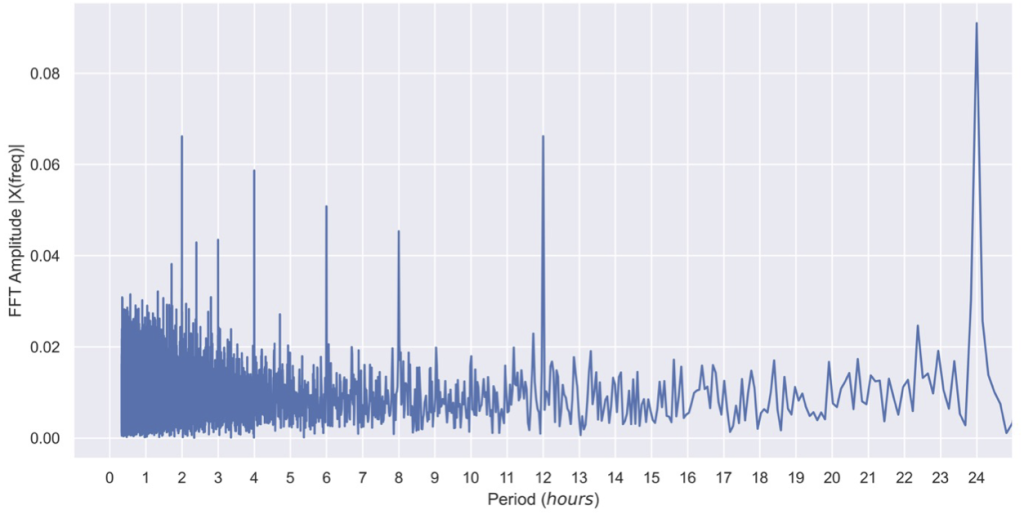
The graph shows the period, in hours, on the y-axis and the amplitude of the signal on the y-axis.
The strongest signal is for a process occurring every 24 hours. This is likely explained by a daily processes, such as areas being opened each morning. There is also a strong signal that something occurs every 12 hours. This period matches the nursing shift length.
Perhaps more interesting is that there is a clear signal of something happening every 2, 4, 6 and 8 hours. This analysis alone cannot tell us what it occurring but it can be helpful in directly further investigations.